Friday, December 4, 2015

"Life Along The Potomac" opens at Bethesda Library


Yesterday evening, Darryl drove us through D.C. rush-hour traffic to the Bethesda Library (7400 Arlington Road), to participate in the “Life Along the Potomac” opening. Members of the Potomac Chapter of the Guild of Book Workers have created a dozen beautiful bindings. The exhibit will be on display at the library through December, and go on view at the Maryland State Archives in Annapolis January 4, 2016. 


Monday, November 16, 2015

Seeing Sycamores

For 25 years, my husband and I have enjoyed walking along, or canoeing on, the Potomac river. I must have seen sycamore trees every time. Yet, until I chose Leaning Sycamores for my binding project, I never really noticed them. Delving into the book has helped me see sycamores in all their variety and beauty. Here's another tree from yesterday's walk. And Darryl, with the Catoctin Aqueduct in the background. The Park has placed markers that describe the restoration of the aqueduct. Businesses and individuals sponsored reclamation of fallen and damaged stones, which were then put back into their original locations. I found parallels to bookbinding and conservation, of course. Now, back to the Bible I am repairing.

Another unique camouflage pattern, with stark shadows cast by late-afternoon sunlight.

Darryl, with the Catoctin aqueduct in the background. My camera battery died so I could not photograph the restored aqueduct up close.

This is the underside of the tree.

Sunday, November 1, 2015

Leaning Sycamores finished

I delivered the book to our exhibit coordinator today! I've been working on this concept since June, with the most intense focus during the past two weeks. It's finished and out of my hands now. I'm coming up for air at last. The opening reception for the exhibit is December 3, 6-8 PM at the Bethesda Library.

The paper has pine-needle inclusions. I bound in the book's original dust jacket.

All four scrolls, completed.

The Potomac River Water Trail maps are beautiful, and printed on high-quality paper--just right for the box.

I decoupaged a sycamore leaf, backed it with Moriki, and inset it into the spine of the box.

This photo I took of a sycamore reflected in water alludes to the author's "reflections" on the natural world.

I printed sycamore-bark photos and then overprinted them with the title. The font is Post Mediaeval, the same typeface used on the book's dust jacket (first photo above).

Friday, October 23, 2015

Leaning Sycamores, Chapters 7-9

I felt the author's intent was to make each chapter a meditation, with a transition to the next chapter. I tried to achieve the same effect with the various papers. Here is Scroll #3. As with the others, each 'scroll' is a three-section codex rolled to fit the curve of the bark when closed and fastened. Do I need to coin a new word? Scodex? Scrolodex?


Sunday, October 18, 2015

Leaning Sycamores Chapters 4 , 5, & 6

I thought a two-tone thread would look nice--like those black-and-gold caterpillars we find this time of year--so I chose black linen thread and gold silk thread, which constantly twisted as I ineptly tried to join the two curved pieces of bark. The "S" shape means the piercings for the inner curves must be closer together than the holes for the outer curves, which makes it harder to keep track of the pairs. I intended the "leaning S" as a play on the book's title, but to be honest the "S" more accurately stands for Stubborn (I refused to quit).


Wednesday, October 14, 2015

Leaning Sycamores, Chapters 1 through 3


It works!


This looks the way I envisioned it! But I have yet to decide where to put the book title, author’s name, and chapter headings. I’m concerned that lettering will ruin the effect. But for me it’s always all about the text, so I will have to figure it out. For now I’ll focus on completing the next three scrolls.

Tuesday, October 13, 2015

Leaning Sycamores, Part 1


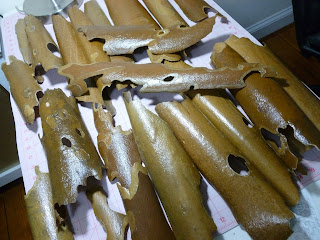
Decoupaged bark, ready to assemble.

Photos of tree trunks, and papers with inclusions, as chapter dividers.

Closeup of sycamore tree trunk.

This little creature gave  me the idea to use a caterpillar stitch.

Reflections

Leaning Sycamores, Part 1

I chose Jack Wennerstrom’s Leaning Sycamores: Natural Worlds of the Upper Potomac to bind for the Potomac Chapter of the Guild of Book Workers exhibition, “Life Along the Potomac.” Darryl and I have taken our daughters to the river many times, and invited friends along. Now that we are empty nesters, we still enjoy walks along the towpath.
    On page 42 the author describes the “scrolls” of bark that drop from sycamore trees. The shed bark looks like old leather—very much like that damaged Bible cover that I’d decoupaged a while ago. Underneath, the trunks are mottled in camouflage patterns of green, gray and gold.
     Over the summer, I gathered sycamore bark and photographed the beautiful trunks. (I also found other remnants along the river: glass beer bottles, cans, plastic water bottles, discarded underwear and condoms.) My paper stash yielded papers with natural inclusions—pine needles, leaves, and ferns. A caterpillar making its way across the towpath at Great Falls became the inspiration for a caterpillar stitch. We shook pawpaw trees and picked up the fruits, whose seeds make beautiful natural buttons.
     Because I wanted to use sycamore bark for the covers, standard bookmaking techniques wouldn’t work. The rectangular book shape couldn’t accommodate the cylinders of bark. 
    How to turn a codex into a scroll? Each chapter is a meditation on the natural world, so I took the book apart and re-made the signatures chapter by chapter. When done, I had 12 sections, divided into four groups. They can be easily curled into a scroll shape that fits the curve of the bark. I went through two bottles of Satin Mod Podge until I had collected and treated enough pieces to begin.
   I’m sewing the covers on now. The November 1 deadline is less than three weeks away. I'll post photos when I'm finished.